

Private Actors Should Underwrite More of Their Own Grid Access
The grid is a social good. Come prepared to make it stronger.

I believe in bringing the tools of prosperity with me so I can underwrite private returns and build social infrastructure.
The Warring Energy behind Infrastructure Moats is Feminine
Why did you think you could come to the common well, and drink without care for who comes before and after, and without the tools to make the well larger? Make the moat wider? - Arushi Sharma Frank, Founder, Luminary Strategies
That question sits underneath almost everything I work on. Not just recently at Luminary. Under everything. My career, has been defined by the act of creation. It looks like this. Unearthing the knowledge of how to create, and applying it to fix broken foundation so it can grow new roots, and create more new branches of progress. The work of the firm is to ensure roots propogate deeper and spreading wider at the surface too, nourishing ecosystems of progress because I cannot stand to do it any other way.
This week at the KPMG flagship event, I was a speaker who taught, but I was also a sponge for learning. I learned from Salim Ismail, who in a single evening dialogue session, spoke my own book back to me as the thesis of bringing feminine energy - energy of creation - back into large tech and industry business building. Yes, that is me, and I am eternally grateful to him for stirring up the sleeping giant in my subsconscious.
“Feminine energy is the warring energy of creation. Not passive energy, not scarcity energy. It is the energy of fighting to build, and winning the fight, so that more is produced, and so that consumption grows in expanding fields of opportunity. It is the antithesis of hoarding, leaning into one’s blinders, hyperfocusing on rent-seeking.” - Arushi Sharma Frank
When I read Deepak Chopra’s take on the eternal feminine, I realized I know this energy far better than he does. He describes it as eternally healing. But it is actually, eternally warring. Before you can heal anything, thus repairing damage, you must disinfect deeply inflicted wounds. Otherwise, they heal from the surface only, and the chasm underneath remains, and nothing new grows. Feminine energy in business-building is about fighting wars against inset disease so the right things grow and life-enabling moats become healthy and strong. In politics, it is about aligning polarized political parties, so that the trend of policy which impacts capital investment in human prosperity, does not jar healing systems back into their most painful and infected states.
It is a disease for example, for America to fight within itself on the question of adopting and quickly deploying energy autonomy, electricity autonomy. No one knows this better than me, and many people know it as well as me.
It was a disease, for utilities - or anyone else - to suggest to the Public Utility Commission of Texas in 2022 that distributed solar-battery access should be gated and blocked away from 6.8 million retail residential energy consumers in Texas.
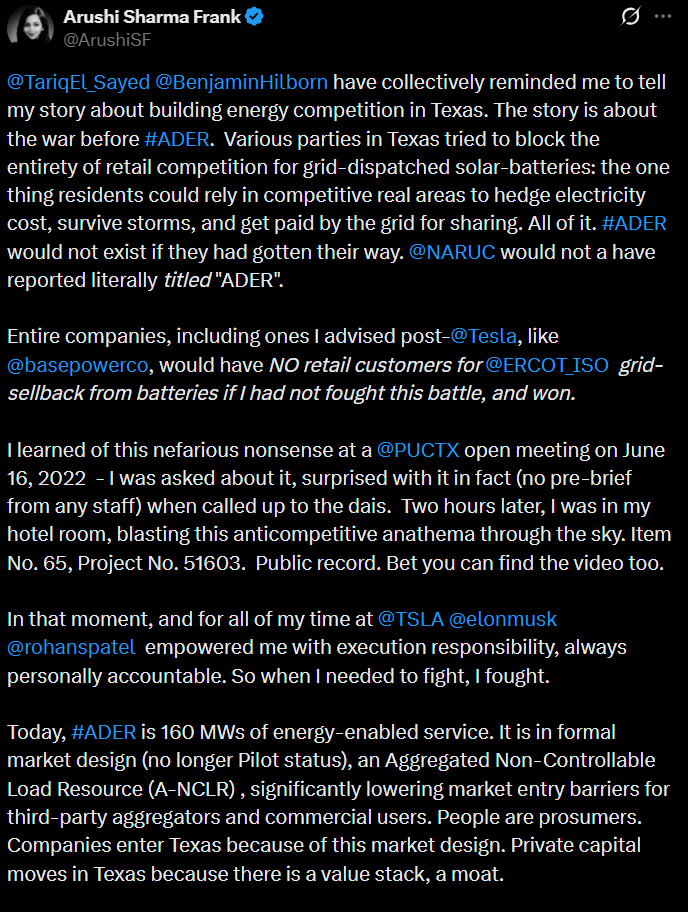
Click to read how I eradicated this disease swiftly in Texas, leading to the Aggregated DER Project:

So, Salim’s work is instructive. How badly Luminary is needed, how badly you might be needed, to fight the wars which are precursors to healing.
The Shape of Grid Healing so AI Creation Can Propogate
It is this through-line - that we have to fight a war to ensure the correct process undergirds building new things - which informs much of my current work and the broader thesis of our Prosperous Infrastructure work.
The electric grid is shared infrastructure. It is a social construct that we have spent more than a century building so that homes, hospitals, factories, businesses, schools, farms, ports and now enormous electronic loads can all participate in modern economic life.
The power grid simply cannot become a common dumping ground for private parties to outsource underwriting of private risk. The grid is not the underwriter of private returns. Period.
If a private actor wants to consume an extraordinary amount of power, accelerate its connection, or build a business model around access to a constrained system, it must contribute private capital to increase the output of social infrastructure, i.e., the accessibility and strength of a social good.
The grid already needs so much healing. There is no surface-level equation to band-aid what we are dealing with, while it festers underneath. No, loads cannot come to the table with no solutions to inculcate true healing.
PCLR in ERCOT is the most recent example of warring my way to enable the right answer - private risk-taking underwrites private returns. The solution allows developers - and ultimately power makers and consumers - to privately underwrite the difference between what the shared system can guarantee and what a large power user business would like to consume.
Sam Brandin, co-founder of Agentic Infrastructure, has helped me shape this thesis as an advised venture. His public comments in ERCOT in the past 10 months are some of the best I have ever heard on the topic.
The Grid Is A Social Good
I recently made this point at KPMG US’s Tech & Innovation Symposium during its Energy: Powering the AI Economy discussion.
The grid is a social grid. It is a social good.
Private companies should make private returns. We want them to. Prosperity depends on businesses investing, building, taking risks and creating value.But a private company approaching shared infrastructure with the expectation that the system will simply absorb all of its risk is asking for something fundamentally different. That breaks the system for everyone over the long term. It is no different than polluting the well you will go back again to drink from.
My message is to come to the shared space with a plan to make the shared space better.
Increase the grid’s usable capacity and improve its controllability.
Bring assets that respond to risks of physics and Acts of God: invest in technology that makes existing infrastructure work harder.
Create operating arrangements that preserve reliability while allowing more economic activity to occur.
Do all of that, and then you can sell stuff. That is how private prosperity and public infrastructure reinforce each other instead of competing with each other.
Underwriting - The Missing Word
We use the word flexibility constantly in the power industry. I am quite tired of it - it is not getting any jobs done, and confusing everyone. It is often too soft a word for what is actually happening. What matters is underwriting.
If a large load wants 1,000 MW but the grid can initially provide only a conservative firm amount, somebody has to carry the risk associated with the rest. Historically, the instinct has often been to ask the grid to solve that problem first: build the transmission, procure the generation, guarantee deliverability, and then allow the private project to arrive.
That model increasingly collides with reality that takes us back to a message we’ve already written: the grid is a social good and it is built with a large stack of insurance via physics, which is bonded to the value of power for everyone, poor and wealthy. To increase it size, it takes time, physical testing, constraint management and serious engineering. Behind all of that, is a quest for serious capital.
If you come to this well, which taks a while to make bigger and wider, come with the extraordinary collection of technoligies that is present today to manage the risk and prevent over-using the resources we actually have before us today.
So the architecture should increasingly look like this:
The grid provides shared infrastructure.
Private actors underwrite their incremental risk.
Dispatchability and private firming make that underwriting credible.
Market design recognizes and rewards the performance.
The result is greater infrastructure deliverability.
That is a very different idea from simply asking customers to be “flexible.”
PCLR Is Private Underwriting in Practice
This is why the Provisional Controllable Load Resource framework we built in ERCOT matters. At its core, PCLR separates what the grid can confidently provide from what a private customer is willing to manage.
The planning system can maintain a conservative firm floor. Above that floor, the customer can consume more power as a dispatchable resource, subject to actual system conditions. The grid does not have to pretend that every megawatt is firm. The customer does not have to wait until every future transmission upgrade is complete. And private industry gains an enormous incentive to figure out how to firm the gap.
That firming can come from batteries, generation, computational response, controls, contracts, software, or some combination of all of them.
The underlying principle remains that getting an inordinate amount of access to shared social infrastructure comes with a willing investment to underwrite more of the risk associated with your own grid access.
That is a far more durable bargain than asking society to guarantee every megawatt before the private project begins.
Prosperous Infrastructure Compounds
This is also why Luminary spends so much time building market architecture rather than merely discussing technology. Good technology sitting outside a usable market construct is stranded capability. The market must be useable, and it must motivate private actors to become the least-cost builders of solutions which grow infrastructure.
We are on the hunt for grids, founders, technologists, utility executives - who understand this and want to deliver the right underwriting solution for electricity prosperity.
-A.S.F.